

Can The Police Access Registered Drones
How law catch drone-flight criminals
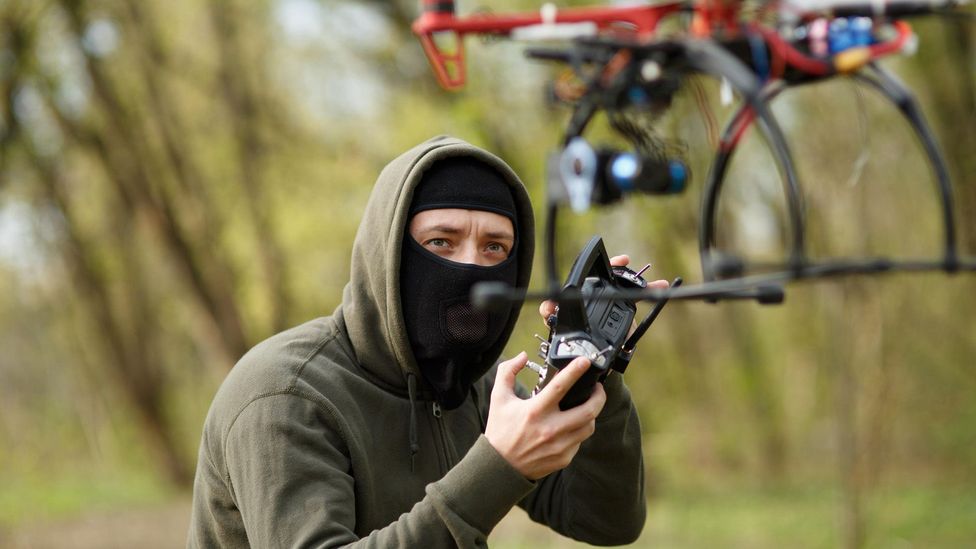
From invading privacy to smuggling drugs over jail walls, more criminals are turning to flight drones – forcing detectives to learn new skills to find them.
A
After spray painting his drone black, and taping over its lights, southward Londoner Daniel Kelly probably thought he had a practiced run a risk of getting away with flying his now-stealthy drone into a prison yard.
So in the early on hours of 25 April last year, he flew the cheap, Chinese-made quadcopter, with what police believe was a package of contraband – tobacco and maybe legal highs – fastened to a hook below it, over the wall of Swaleside jail on the Isle of Sheppey, in Kent.
Unfortunately, he overestimated his chances: he ended up jailed for 14 months, becoming the first person in Britain to be locked up nether legislation that punishes such behaviour.
Only Kelly isn't alone. He's just one amongst many people worldwide who take discovered the potential that low-toll consumer drones take for illegal activities.
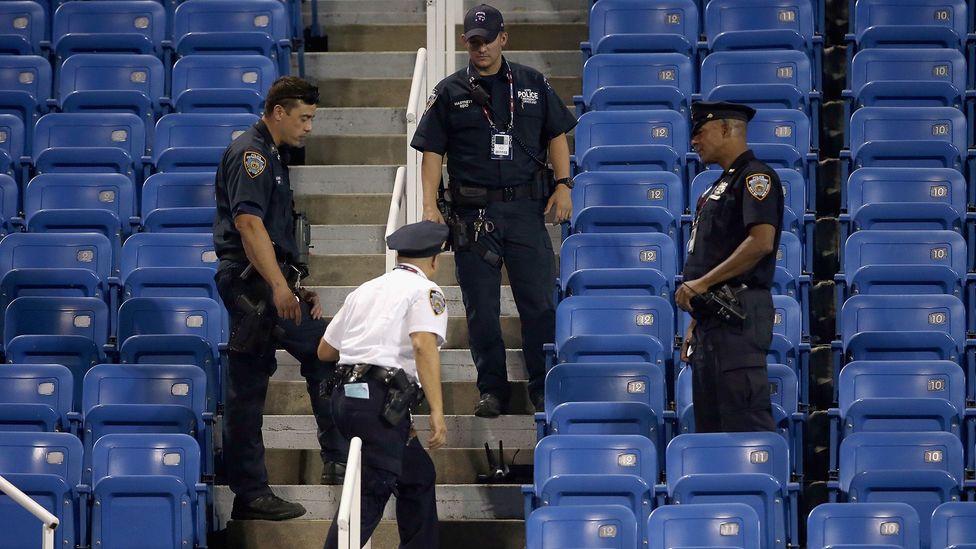
Even if a drone has been destroyed, police tin find the airplane pilot with information in the 'digital ecosystem' to which the drone is connected, via devices like phones (Credit: Getty)
And now, investigators are launching new forensic intelligence forces of detectives to get to the bottom of drone-related crimes.
Whether information technology is flying illicit goods into forbidden places, spying on people, interrupting the work of the emergency services or worrying wild animals or aircraft, the threat they present is growing. Only a couple weeks ago, for instance, a drone forced five flights at London's Gatwick Drome to exist diverted.
Identifying the pilots of remotely-controlled drones is not ever piece of cake. Drones are inexpensive, piece of cake to fly, and widely bachelor to consumers nowadays. Plus, governments are struggling to legislate fast enough to go on pace with burgeoning criminal possibilities.
That'due south why more police forces are turning to drone forensics teams: it might sound like the TV programme CSI, but it's a growing trend of more than detectives whose jobs it is to track down flyers of rogue drones.
The rise of drone detectives
Just a few months agone, information technology was announced that the United kingdom of great britain and northern ireland Prison Service and police force are pooling resource to end drone pilots from flying drugs and other contraband into British prisons, with reports suggesting that £3m could be spent on the new task forcefulness.
At that place's a reason drone action has piqued the interest of police force enforcement. Drones deliver much more than than drugs to jailbirds: they've been used to wing in mobile phones, hacksaw blades, knives, Sim cards, USB drives and DVD players. Not to mention they can wing over walls and barriers, complicating the operations of institutions ranging from government buildings to airports.
This makes the identification of the drone pilot crucial for law enforcement.
While Kelly'south example was rare in that the pilot, the drone and the smartphone/controller combination used to operate information technology were all captured together. And the drone independent valid flying data that had not been erased or otherwise tampered with.
But how can a criminal pilot exist identified when, say, merely a drone is found at a criminal offence scene? Or when only fragments from wreckage are constitute? Or when only a controller or phone is plant, or when police accept a likely airplane pilot suspect but no drone?
This is where the drone detectives come in.
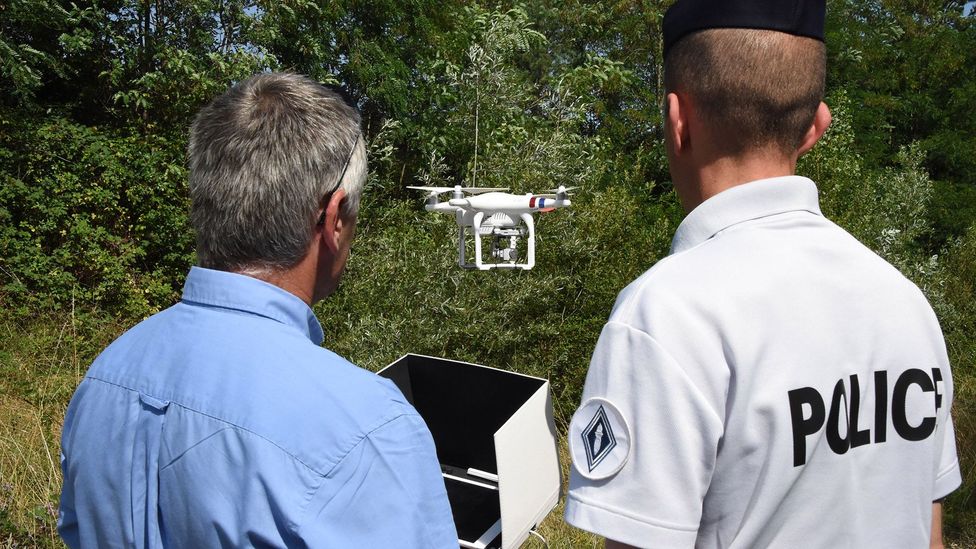
Law enforcement agencies around the world are scrambling to go along upwardly with drone technology and then they can improve slice together clues in drone-related crimes (Credit: Getty)
Tying the digital and physical facets of drone flight to a human pilot is non easy. This has led to a perception that, with drones controlled wirelessly from a altitude, often unseen, it's an like shooting fish in a barrel crime to get abroad with. Drones are cheap, after all, and can be abandoned if the flyer fears arrest.
Just just as investigators only began to understand the enormous forensic resource that mobile phones represent around the turn of the century, the tougher challenges of drone forensics are now quietly beginning to be met, too.
All these issues are adding upward to a need for more investigative tools, says James Mackler, an attorney specialising in drone litigation at Mackler Police Firm in Nashville, Tennessee.
"Drone forensics are becoming increasingly important as more drones accept to the air. Civilian commercial drones are now being used by terrorist organisations and the fact that they are existence weaponised makes forensics all the more disquisitional." He knows the risks more than most: he'due south a sometime US Army helicopter pilot who flew missions alongside military drones in Republic of iraq.
The need for drone-specific law enforcement extends to civilian safe, too. Crowds at football matches, concerts and protest marches accept been regularly buzzed and endangered, too. At Seattle's 2016 Pride parade, for instance, a woman suffered concussion after a drone smashed into a edifice and dropped on her.
And, of course, the drone'southward potential for invasion of privacy is profound, leading some people to shoot them down with all the risks public firearms use entails. Indeed, that has led to Mackler attempting to analyze drone airspace law after one of his clients had his drone shot down by a neighbour – and a federal judge permit the shooter get away with it. It'due south not clear in US law, Mackler says, where a householder's airspace ends and FAA-governed civilian airspace begins.
Unlocking the system
So how will regime catch whatever drone-flying criminals?
The secret isn't in the bulky device itself, says David Kovar, a digital investigator and cybersecurity consultant based near Boston, Massachusetts. Information technology'south the fact that it's part of a complex digital ecosystem.
This "ecosystem" includes peripheral devices like smartphones, controllers, and sensors that collect information like GPS position and crash analysis information from accelerometers, compass heading, and video images. And metadata in the video will reveal where shots were taken, including distance.
So investigators do really have a lot to keep forensically, Kovar says, even if they don't accept all the physical components. After all, a drone may crash and fracture into pieces, or only a remote may be recovered at the scene.
"But of them all, the biggest source of data is the mobile device, the phone or tablet," Kovar says. And investigators are well versed in pulling those apart.
But here'south the challenge: it is a diverse marketplace. Each drone has its own digital quirks.
How does the drone in question store flight data? How long does it store the latitude and longitude coordinates of where it was launched from? What information from the airplane pilot's phone-based control app ends up stored in the drone too? Plus, dissimilar drones use unlike operating systems, so analysts demand to be well-versed in each.
Sometimes the makers unwittingly help forensics teams: one drone model injects the user's flight control app login and password – unencrypted or "in the clear" in tech jargon – on the drone. This means officers can merely log into a copy of the app and examine a user's flight video and records in cases where a crashed or dumped drone is found at a offense scene and there is no trace of the pilot.
But sometimes entire drones are plant intact, too.
"We have already been involved in the forensic assay of drones recovered in prisons, or found crashed past police forces and the Ministry building of Defense," says Michael May, manager of FlyThru Limited of Huddersfield, a commercial drone operator in the U.k.. "They demand to discover out why they were in that location and we tin comment forensically on whatever we can find on them, whether it is on the flying log information in the drone itself, or the DNA and fingerprints on it."
A drone'due south rotors are reasonably abrupt edged and retain traces of skin cells, he says, so they tin can sometimes retrieve DNA. And in that location are parts like the SD cards – for storing video – and batteries where users tin can leave fingerprints as they insert them.
Information technology all sounds done and dusted, but some expert drone users are pretty clued upwards about hiding information.
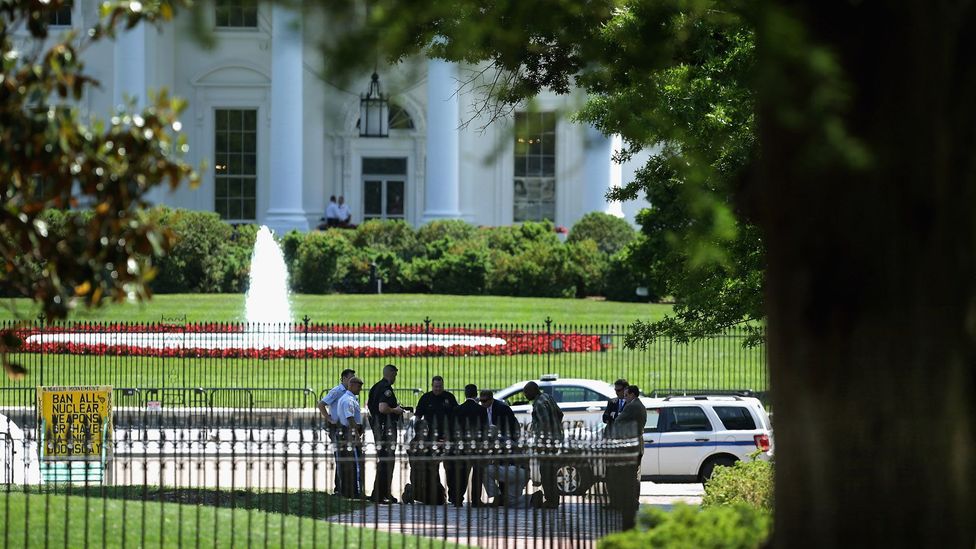
More than drones have been flown effectually highly sensitive government buildings, from the White Business firm in the US to the Prime number Minister's office in Japan (Credit: Getty)
And then Graeme Horsman, a computer scientist and digital investigator at the Academy of Sunderland, took apart ane cheap drone and institute that there are a number of tricks a user could play to obscure where the drone has flown. He constitute it was possible to mask a drone'due south flightlog past turning off sure phone settings. He could also force the drone to store a fake location for the pilot'due south launch point.
In other words, it's easy for a drone airplane pilot upwardly to no good to encompass their tracks.
Even by wrapping aluminium cooking foil around the GPS antenna, Horsman created a Faraday muzzle – or radio wave absorber – that prevented the drone logging its flight.
But it's easy for that heavily protected digital information to vanish in thin air, fifty-fifty if the drone notice its way into the hands of the authorities.
Turning a found drone off, or only plugging in a USB cablevision, can cause data to be overwritten - and moving it tin can similarly overwrite GPS data. It all means it's vital to sympathize each popular drone earlier mishandling it or attempting forensics, Horsman says. "There are a lot of variables, so every drone investigation will be different."
Kovar says drones are already being seized for analysis: "Law enforcement seized a protester's drone at the North Dakota pipeline protests. I do not know who is doing the assay of that drone. The drone that landed on the White House lawn was certainly analysed. And I know that people on the intelligence side are analysing drones captured from Isis on the battleground."
What's nearly foreboding, however? Experts concord: we haven't seen the worst criminals and terrorists tin can practise with drones. That'south why being able to identify the pilot is becoming more pressing.
"The worrying thing is that some of our drone platforms tin can carry 15kg (32lb) payloads. That's a hell of a lot. Terrorists could switch from using truck bombs to ones they trigger from above," May says. He warns that some could even fly international missions as drone range increases. It's even possible a bioweapon – like anthrax – could be dispersed by a drone.
"This is an emerging technology and nosotros cannot predict the number of dodgy ways drones are going to be used in hereafter," says Horsman. "I think we are going to be constantly surprised at what people do with them - information technology's only limited past the imagination of the criminal."
Spray-painted drones, with taped over lights, look similar being the very least of our problems.
--

Can The Police Access Registered Drones,
Source: https://www.bbc.com/future/article/20170731-how-cops-catch-drone-flying-criminals
Posted by: flemingsadelthe2000.blogspot.com
0 Response to "Can The Police Access Registered Drones"
Post a Comment