

How To Use Stod In C++
What is Structure information type?
A construction is a keyword that creates user-divers data types in C/C++. A structure creates a data blazon that can exist used to group items of perhaps different types into a single type.
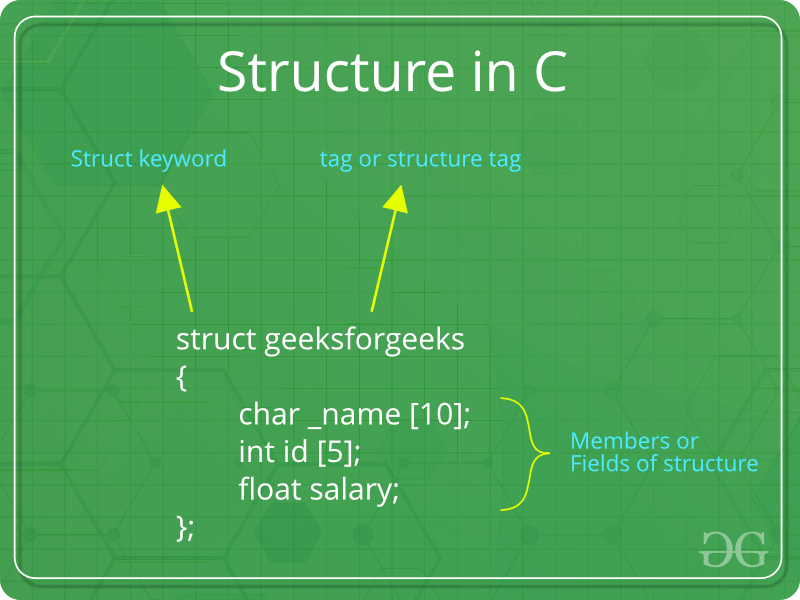
Where to use the Structure data type?
We can use this data type to store dates of unlike attributes of different data types.
For example, If we want to store information on multiple patients such equally patient name, historic period, and blood group.
How to create a structure?
'struct' keyword is used to create a structure. Post-obit is an instance.
C
struct address
{
char name[l];
char street[100];
char city[l];
char state[xx];
int pin;
};
How to declare structure variables?
A structure variable can either exist declared with structure declaration or as a separate declaration like basic types.
C
struct Point
{
int x, y;
} p1;
struct Point
{
int x, y;
};
int chief()
{
struct Point p1;
}
Note: In C++, the struct keyword is optional before in proclamation of a variable. In C, information technology is mandatory.
How to initialize structure members?
Structure members cannot be initialized with annunciation. For example, the following C program fails in the compilation.
C
struct Signal
{
int ten = 0;
int y = 0;
};
The reason for above error is simple, when a datatype is declared, no memory is allocated for information technology. Retentivity is allocated only when variables are created.
Structure members can be initialized using curly braces '{}'. For example, the following is a valid initialization.
C
struct Point
{
int x, y;
};
int main()
{
struct Betoken p1 = {0, one};
}
How to access construction elements?
Structure members are accessed using dot (.) operator.
C
#include <stdio.h>
struct Signal {
int x, y;
};
int main()
{
struct Point p1 = { 0, 1 };
p1.x = xx;
printf ( "x = %d, y = %d" , p1.10, p1.y);
return 0;
}
What is designated Initialization?
Designated Initialization allows structure members to be initialized in whatsoever gild. This feature has been added in C99 standard.
C
#include <stdio.h>
struct Point {
int x, y, z;
};
int main()
{
struct Bespeak p1 = { .y = 0, .z = i, .ten = ii };
struct Point p2 = { .10 = 20 };
printf ( "x = %d, y = %d, z = %d\n" , p1.x, p1.y, p1.z);
printf ( "ten = %d" , p2.x);
return 0;
}
Output
10 = 2, y = 0, z = 1 x = 20
This characteristic is not bachelor in C++ and works just in C.
What is an assortment of structures?
Like other primitive data types, we can create an array of structures.
C
#include <stdio.h>
struct Indicate {
int ten, y;
};
int main()
{
struct Point arr[10];
arr[0].ten = 10;
arr[0].y = xx;
printf ( "%d %d" , arr[0].x, arr[0].y);
return 0;
}
What is a structure arrow?
Similar primitive types, we tin can have a arrow to a structure. If we have a arrow to structure, members are accessed using arrow ( -> ) operator.
C
#include <stdio.h>
struct Point {
int x, y;
};
int main()
{
struct Point p1 = { 1, 2 };
struct Point* p2 = &p1;
printf ( "%d %d" , p2->x, p2->y);
render 0;
}
What is structure fellow member alignment?
See https://world wide web.geeksforgeeks.org/structure-member-alignment-padding-and-data-packing/
Limitations of C Structures
In C language, Structures provide a method for packing together data of different types. A Structure is a helpful tool to handle a group of logically related information items. Even so, C structures have some limitations.
- The C structure does non allow the struct information type to exist treated like built-in data types:
- We cannot use operators like +,- etc. on Construction variables. For example, consider the following code:
C
struct number {
bladder x;
};
int principal()
{
struct number n1, n2, n3;
n1.ten = iv;
n2.10 = 3;
n3 = n1 + n2;
render 0;
}
But we can use arithmetic performance on structure variables like this.
C
#include <stdio.h>
struct number {
float 10;
};
int main()
{
struct number n1, n2, n3;
n1.10 = four;
n2.x = 3;
n3.ten = (n1.x) + (n2.x);
printf ( "\n%f" , n3.ten);
return 0;
}
- No Data Hiding: C Structures do not let data hiding. Structure members can be accessed by any function, anywhere in the scope of the Structure
- Functions inside Structure: C structures do not allow functions inside Structure
- Static Members: C Structures cannot take static members inside their torso
- Access Modifiers: C Programming language does non support access modifiers. So they cannot exist used in C Structures.
- Structure cosmos in Construction: Structures in C cannot have a constructor inside Structures.
Related Commodity : C Structures vs C++ Structure
We will presently be discussing union and other struct-related topics in C. Please write comments if you find annihilation incorrect, or y'all want to share more than information about the topic discussed in a higher place.
Source: https://www.geeksforgeeks.org/structures-c/
0 Response to "How To Use Stod In C++"
Post a Comment